- Need Free Consultation?


Research
- Home
- Research

Research - 1 | January 8
Research Funded by National Oceanic and Atmospheric Administration (NOAA) Grant Number NA22NMF4270162-T1-01
Investigators: Dr. Tawainga Katsvairo (Arc Horizon LLC), and Mark Maynard Sr, Mark Maynard Jr (Southeastern Seaproducts Inc.)
Collaborators: Leslie Sturmer (University of Florida), Rosanne Cantwell, (Dog Island Blues Clam Company Inc.), John Schleede, (Cedar Key Seafood Distributors, Inc.) and Philips Sapelo (Sapelo Sea Farms)
Southern and Southeastern states predominately grow the northern hard clam, Mercenaria mercenaria. While it is the standard clam, growing M. Mercenaria has both production and marketing challenges. M. mercenaria is not as adapted to the prolonged hot summer months; low dissolved oxygen levels can result in mortality rates of 50% or more of clams reaching market size, resulting in huge losses that reduce growers revenue (Sturmer et al., 2009).
Northern states prohibit the harvest and marketing of M. mercenaria small clams. On the other hand, growing and marketing of smaller clams enable shorter crop grow out times and reduce production risks and expenditures. American growers are not able to participate on the small clams market as we cannot sell small M. mecenaria, forgoing this lucrative market, which comprise a third of the US trading clams.
The region has always been aware of the value of hybrids, a cross between M. mercenaria and M. campechiensis, as an alternative to the standard M. Mercenaria. For decades, going back as far as the 1960s Florida has sought to culture hybrid clams. Research conducted by Florida State and University of Florida produced hybrids better adapted for the Gulf of America conditions. M. campechiensis, native to the region, produces hybrids better adapted hybrids to provide resilience to the clam industry.
The hybrid clams will be marketed to northern states as small clams, enabling domestic growers to compete with imports. The ultimate success of hybrids will depend on whether consumers will purchase the hybrids.
We conducted sensory tastes between hybrids and M. mercenaria. We evaluated attributes including overall liking, color, size, aroma, flavor, saltiness, savoriness, aftertaste, texture, moisture, purchase intend, meet expectation and preference on hedonic questions.
The objectives were to:
- determine consumer acceptance for raw vs cooked M. mercenaria and hybrid clams
- compare consumer acceptance between hybrid clams and M. mercenaria for sensory attributes that influence consumption
- evaluate the likelihood of consumers purchasing hybrid clams in comparison to the standard M. mercenaria.
Sensory Taste: Hybridization in Clams to Achieve Efficiency and Larger Markets
Results
Overall consumers liked cooked clams compared to raw clams across both hybrids and M. mercenaria. In general, there was a preference for cooked clams in terms of color, size, aroma, flavor. This was true across both hybrids and M. mercenaria. The overall liking for cooked clams confirms the market trend towards ready-to-eat meals. Ready to eat meals offer convenience to those with busy lifestyles and with guaranteed consistency in taste and quality. Likely, cooked clams would have stronger flavor compared with raw clams.
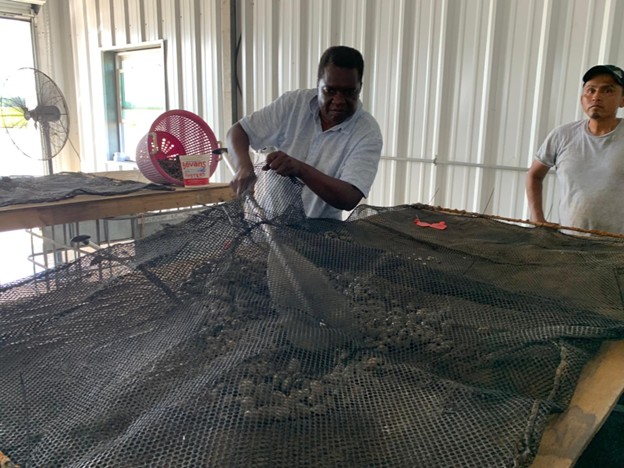
Dr. Tawainga Katsvairo re-baging clams to take back to the submerged water after determining baseline data measurements during production.
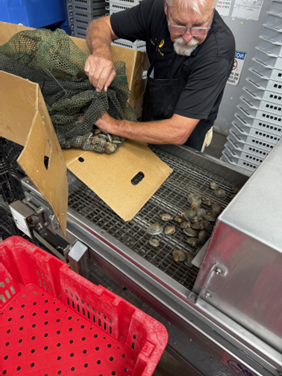
Investigator, Mark Maynard processing hybrid clams
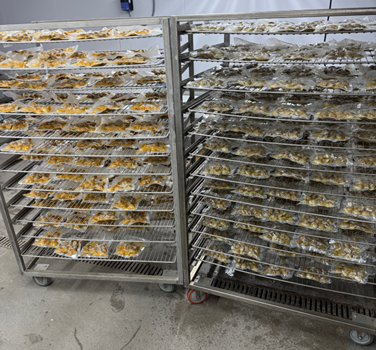
To the left are cooked M. mecenaria clams and cooked hybrids to the right
Saltiness: The consumers prefered raw M. mercenaria clams for saltiness and found the hybrids too salty. The saltiness in the raw clams could have been a direct result of seawater. The consumers reported cooked clams for both hybrids and M. Mercenaria as not salty enough.
Moisture: Consumers liked the moistureness of raw M. mercenaria and raw hybrids and reported cooked M. mercenaria and cooked hybrids as too dry.
Purchase Intent: The ultimate goal of this resarch was to determine if consumers would purchase hybrid clams. Overal there is as much interst to purchase the hybrid clams as is for the standard M. mercenaria, encouraging and succeess for hybrids. The panelists showed intend purchase cooked over raw clams. Conusmers will purchase ready to eat meals such as cooked clams for convience, particualrly because ready to east meals removes the chores of cooking to save time. Cooked clams are benefical for people with busy chedules.
Preference: There was no preference for either raw M. mercenaria and raw hybrid and no significant preference for either cooked M. mercenaria and cooked hybrid. The resultes support earlier results from the University of Florida that showed no differences in acceptance or preferences for hybrid clams over M. mercenaria sold as fresh clams (Sturmer et al., 2009).
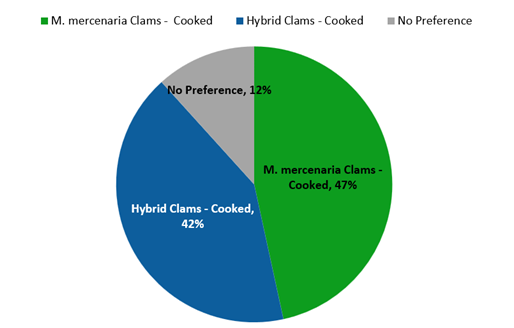
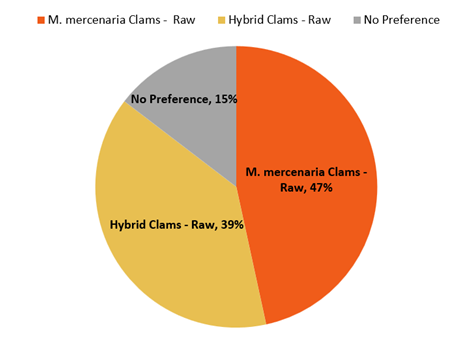
The main hypthoesis was to test whether consumers would purchase hybrid clams over M. mercenaria. The fact that consumers have no preference for one or the other make hybrid clams an attaractive alternative to standard M. mercenaria clams. Hybrids are better adaptoed to the region with low mortality rates. Hybrid clams are exempt from the size laws that specifically pertain to M. mercenaria and can be marketered as small clams in northen states, providing new lucrative markets to growers.
Conclusion
Overall consumers prefered value added cooked clams over raw clams for convience and as ready to eat seafood. Cooked clams including both hybrids and M. mercenaria generally had more acceptable aroma, falvor and color. Consumers showed greater expectations for cooked clams compared to raw clams. Consumers are equally willing to purchase hybrid clams as much as the standard M. mercenaria. The findings provides support for growers to grow hybrid clams.
Sensory Taste: Hybridization in Clams to Achieve Efficiency and Larger Markets





Research - 2 | January 8
Growth Characteristics: Hybridization in Clams to Achieve Efficiency and Larger Markets
We conducted on-farm research to replicate growers’ experience and real life to determine viability of growing hybrids clams in Sapelo, GA. We measured several growth characteristics including survival, shell length, shell width, total weight and wet meat weight.
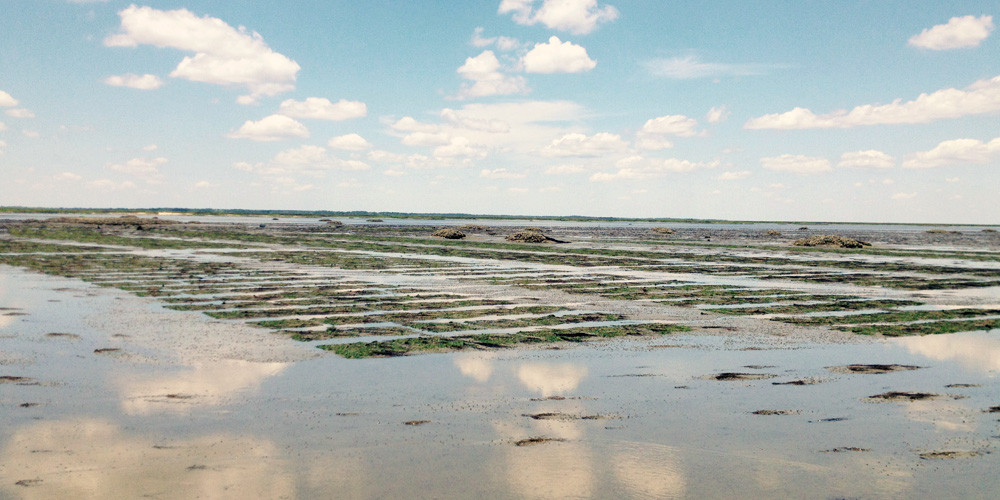
Clam Production at Experimental Site in Sapelo, Ga.
Survival
In terms of survival, M. mercenaria had a higher survival rate, 94%, compared to 89 percent for the hybrids. Table 1.
Table 1. Survival Rates Between M. mercenaria and Hybrid Clams
| Hard Clam | Replicate | #Dead | # ≥ Littleneck | % Littleneck | Total Live | % Survival | |
| 1 | 49 | 889 | 100.00 | 889 | 94.78 | ||
| 2 | 56 | 884 | 100.00 | 884 | 94.04 | ||
| 3 | 62 | 904 | 100.00 | 904 | 93.58 | ||
| Average | 55.67 | 892.33 | 100.00 | 892.33 | 94.13 | ||
| StDeviation | 6.51 | 10.41 | 0.00 | 10.41 | 0.60 | ||
| Hybrid Clam | Replicate | # Dead | # ≥ Littleneck | % Littleneck | Pasta | Total Live | % Survival |
| 1 | 151 | 575 | 43.89 | 735 | 1310 | 89.66 | |
| 2 | 124 | 202 | 18.60 | 884 | 1086 | 89.75 | |
| 3 | 155 | 716 | 60.78 | 462 | 1178 | 88.37 | |
| Average | 143.33 | 497.67 | 41.09 | 693.67 | 1191.33 | 89.26 | |
| StDeviation | 16.86 | 265.58 | 21.23 | 214.01 | 112.59 | 0.77 | |
| P-value* | 0.0212 | 0.0034 |
Although statistically different, the survival rates for both clams is high and acceptable. It should be noted that in Florida, survival rate can be as low as 50% due to the high water temperature conditions in summer.
Growth Characteristics
M. mercenaria overall grew bigger than the hybrids. Growth parameters including shell length, shell width, total weight and wet meat weight were greater for hybrids compared to M. mercenaria. Table 2.
Table 2. Comparison of shell Length, Width, Total Weight and Wet Meat Between Two Clam Types
| Hard Clam | Replicate | Shell Length (mm) | Shell Width (mm) | Total Wet Weight (g) | Wet Meat Weight (g) |
| 1 | 49.95 | 26.71 | 35.90 | 3.90 | |
| 2 | 47.59 | 25.67 | 31.30 | 3.10 | |
| 3 | 50.22 | 27.00 | 36.50 | 3.60 | |
| Average | 49.25 | 26.46 | 34.57 | 3.53 | |
| StDeviation | 1.45 | 0.70 | 2.84 | 0.40 | |
| Hybrid Clam | Replicate | SL | SW | TW | WMW |
| 1 | 43.42 | 23.84 | 24.60 | 2.70 | |
| 2 | 39.04 | 21.36 | 18.00 | 2.30 | |
| 3 | 41.37 | 22.51 | 20.30 | 2.40 | |
| Average | 41.28 | 22.57 | 20.97 | 2.47 | |
| StDeviation | 2.19 | 1.24 | 3.35 | 0.21 | |
| P-value* | <0.0005 | <0.0005 | <0.0005 | <0.0005 |
Research conducted by Florida State University and the University of Florida over decades showed hybrids performing better than M. mercenaria Dalton and Menzel, 1983; Menzel, 1961; Menzel, 1962; Menzel, 1977; Scarpa et al., 2011; Sturmer et al., 2012). This research was done in the warm waters of Florida. Waters in Georgia are relatively colder than Florida.
Among the objectives of the research was to establish viability of growing hybrid clams. The research showed that hybrid clams have the potential as an alternative to M. mercenaria in Georgia. In Georgia, hybrids offer the major advantage of small clams being sold to small clams’ markets at shorter growth periods half as opposed to waiting for maturity in three years.